A professional learning programme for teachers and leaders who want to use AI and new technology with purpose, not hype: to save time, teach better and prepare students for a world that changes faster every year.
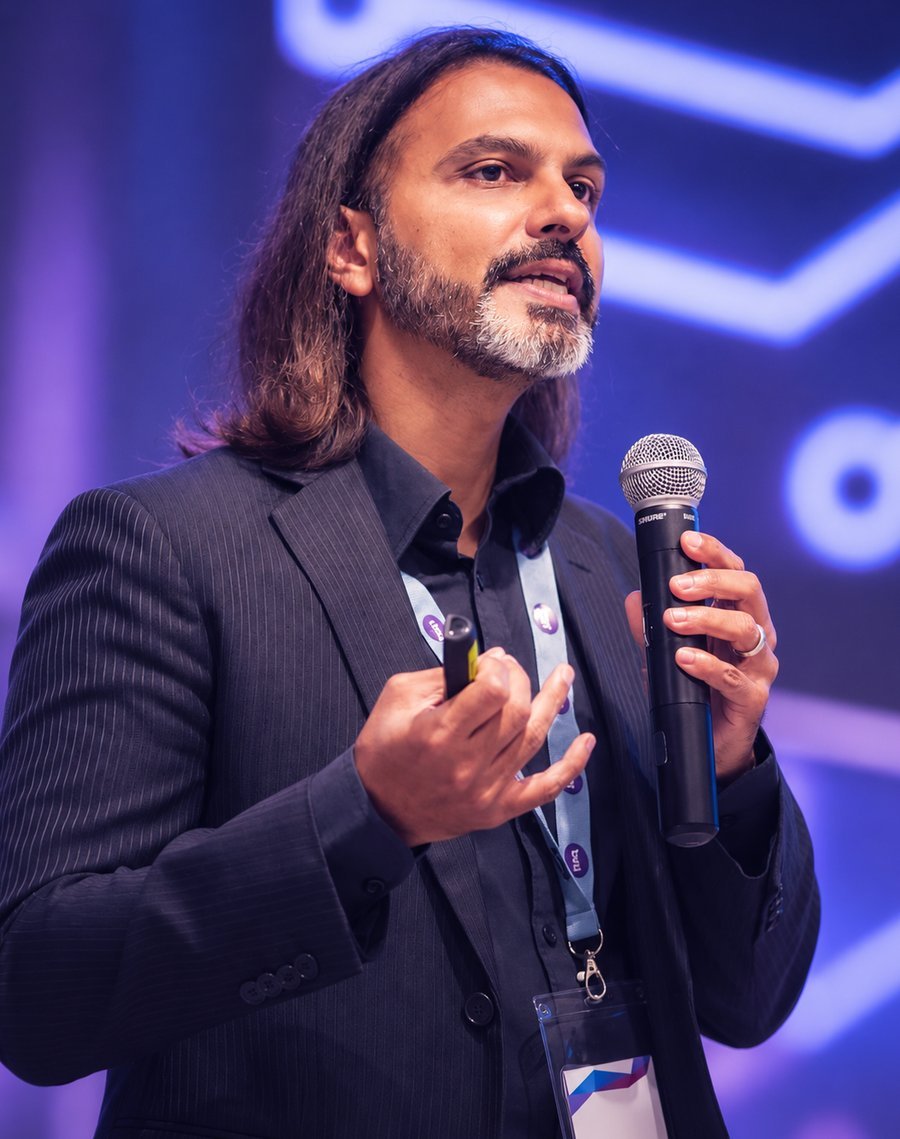
Programme designed by Rohan Roberts · lead designer
Take thirty ordinary steps and you cross a room. Double thirty times and you pass a billion. Our minds expect the first kind of change. Computing power, data and AI follow the second. That is why technology seems to move slowly, and then all at once.
30after 30 linear steps
1,073,741,824after 30 doublings (230)
Why it matters now
AI is already in every classroom. The question is whether teachers lead it.
Our students will live with AI every day.
They need to understand it, question it and use it well, and they will learn most of that from their teachers.
Teachers deserve tools that save time.
Used well, AI can take on routine planning and admin so teachers can spend more time with students.
Old tasks no longer measure learning.
When machines can write and solve, schools must rethink what students do and how we judge it.
Fairness is at stake.
Without care, AI can widen gaps. With care, it can bring good tutoring to many more children.
Did you know?
Four markers for the AI classroom.
2 sigma
one-to-one tutoring lifted students about two standard deviations above a normal class
Bloom, “The 2 Sigma Problem”, Educational Researcher, 1984
2 months
for ChatGPT to reach an estimated 100 million users, then the fastest-growing consumer app on record
UBS study, reported by Reuters, February 2023
2023
UNESCO published its first global guidance on generative AI in education and research
UNESCO, Guidance for Generative AI in Education and Research, 2023
2024
UNESCO set out the competencies every teacher needs for working with AI
UNESCO, AI Competency Framework for Teachers, 2024
The programme
Eight modules. From curiosity to leadership.
Each module mixes a short input, hands-on time with real tools, a strategy to try with a class, and an honest look at the risks. Teachers leave with things they can use on Monday.
MODULE 01
Thinking Exponentially
Why change feels slow, then sudden
Our instincts are linear; technology is not. Teachers explore doubling, accelerating returns and what they mean for the students in front of them.
Linear and exponential: the doubling story
Moore’s law and accelerating returns
Six Ds of exponential technologies
What this means for a child starting school today
MODULE 02
How AI Actually Works
No magic, just maths and data
A plain-words tour of machine learning, neural networks and large language models, so teachers can explain AI with confidence and spot hype.
From rules to learning from data
Neural networks in one picture
How a language model writes a sentence
What AI is good at, and where it fails
MODULE 03
Generative AI in the Classroom
A partner, not a shortcut
Hands-on practice with AI tools for planning, feedback and creativity, with clear routines that keep students doing the thinking.
Prompting with purpose
Planning, adapting and differentiating
AI for feedback, not answers
Classroom routines that protect thinking
MODULE 04
AI Tutors and Personal Learning
Chasing Bloom’s two sigma
In 1984 Benjamin Bloom found that one-to-one tutoring lifted students far above a normal class. Teachers explore what AI tutors can and cannot do toward that goal.
The two sigma problem
Adaptive and mastery learning
What good tutoring looks like
Keeping the human relationship at the centre
MODULE 05
Assessment in the Age of AI
Rethinking what we ask students to show
If a machine can write the essay, what should we assess? Teachers redesign tasks to value process, reasoning, voice and real-world work.
Why detection is a dead end
Process portfolios and oral defence
Authentic, local and personal tasks
Using AI openly and honestly
MODULE 06
Ethics, Bias and Data
Who is the system built for?
AI can repeat and scale unfairness. Teachers learn how bias enters data and models, how to protect student privacy, and how to teach students to question technology.
How bias gets into AI
Privacy, consent and student data
Power, labour and the hidden costs of AI
Teaching critical AI literacy
MODULE 07
The Exponential Toolkit
Beyond AI
A guided tour of the other fast-moving technologies reshaping learning and work: robotics, VR and AR, 3D printing, biotech, space and quantum.
Robotics and coding
Virtual and augmented reality
Making and 3D printing
Biotech, space and quantum: the next wave
MODULE 08
Leading the Shift
From early adopters to a whole school
Leaders build an AI policy, a training plan and a culture of careful experiment, so change is shared, safe and measured.
Writing a clear, human AI policy
Pilots, evidence and scaling up
Bringing parents and students with you
A three-year roadmap
Human in the loop
AI should make teachers more human, not less.
A simple frame the programme returns to again and again: give machines the routine, keep people at the heart of learning.
AI can
Draft, summarise and translate
Suggest practice questions at the right level
Give fast first feedback
Spot patterns in lots of data
Teachers do
Know each child and what they need
Decide what is worth learning
Judge quality, fairness and truth
Inspire, care and build trust
Students do
The thinking, the struggle and the making
Question what the machine says
Explain their reasoning in their own voice
Use AI openly and honestly
Outcomes
What teachers take back to school.
Explain how AI works to colleagues, students and parents
Use generative AI to plan and give feedback, with clear routines
Redesign assessment so it still measures real learning
Spot bias and protect student data
Teach students to use AI critically and honestly
Lead an AI plan for a department or a whole school
“We can only see a short distance ahead, but we can see plenty there that needs to be done.”
Alan Turing, Computing Machinery and Intelligence, 1950
The thinkers
The minds shaping AI and learning.
Alan TuringTheoretical computer science and the Turing machine
Ray KurzweilAI and the singularity
Peter DiamandisExponential technologies
Fei-Fei LiComputer vision and human-centred AI
Cynthia BreazealSocial robots and intelligent machines
Daphne KollerCo-founder of Coursera
Sal KhanKhan Academy, free education for all
Sugata MitraThe Hole in the Wall
Rose LuckinAI in education
Ethan MollickAI and the future of learning
Kate CrawfordAI, power and data
Joy BuolamwiniAlgorithmic bias and equitable tech
The designer
Designed by Rohan Roberts.
Rohan Roberts is the lead designer of EdTech: AI and Exponential Technologies. He built it for educators who want to meet AI with curiosity and judgement rather than fear or hype.
The programme brings together research on learning, the latest AI tools and a clear ethical frame, and turns them into routines, tasks and plans that work in real schools.
 Alan Turing
 Ray Kurzweil
 Peter Diamandis
 Fei-Fei Li
 Cynthia Breazeal
 Daphne Koller
 Sal Khan
 Sugata Mitra
 Rose Luckin
 Ethan Mollick
 Kate Crawford
 Joy Buolamwini