A curriculum for older teens with curious minds and an existential bent. Jason Silva’s short films become the starting point for deep dives into the complex systems of society, technology and human existence, and the truth and beauty of science, in a form of existential jazz.

Ever ponder the miracle of life, or the scale of the cosmos?
Ever wonder about the emergence of intelligence, and the complexity of the human mind?
Ever contemplate the wonder of our existence, and the mystery of our future?
Join us as we explore Jason Silva’s Shots of Awe in depth, as he chases his inspiration addiction through these questions and more.“To be inspired is the ultimate antidote to existential despair.”Jason Silva
Ask a high school student to name a role model and you will usually hear a pop star, an actor or a sports hero. Students who are eloquent, curious and philosophically minded often hide it, to avoid being labelled a geek or a nerd. Their existential intelligence is easily ignored.
Jason Silva fills that gap. He makes it cool to be curious. His Shots of Awe take hard ideas from scientists and philosophers, distil them, connect them, and give them back as three-minute bursts of wonder.
Shots of Awe: Deep Think uses those films as a stimulus for real learning: learning for the sake of learning, not for a grade or a test. Each film opens a session of close reading, research, discussion and debate.

Rohan Roberts was the lead designer of Shots of Awe: Deep Think. Seeing how much Jason Silva’s films inspired young minds, he built a curriculum around the ideas they explore.
He created it together with a small group of highly able students, as a student-led, Creative Commons curriculum that anyone can use, adapt and share. It was first shared through SciFest Dubai and later on Awecademy.org.
To co-create a student-led, Creative Commons curriculum that takes an inter-disciplinary approach to thinking and learning, using Silva’s Shots of Awe videos as a stimulus.
Weighing ideas, evidence and claims, line by line.
Leaping across subjects to find the unexpected link.
Turning big ideas into things students make and share.
Imagining where technology and humanity could go next.

Jason Silva is a media artist, futurist, philosopher, keynote speaker and TV personality. He is the Emmy-nominated host of National Geographic’s hit series Brain Games, seen in more than 100 countries.
Shots of Awe is his short-film series of “trailers for the mind”: philosophical espresso shots on innovation, technology, creativity, futurism and the metaphysics of the imagination. The films have been watched more than 13 million times.
Nine films at the heart of the curriculum. Each one opens a session. Press play.
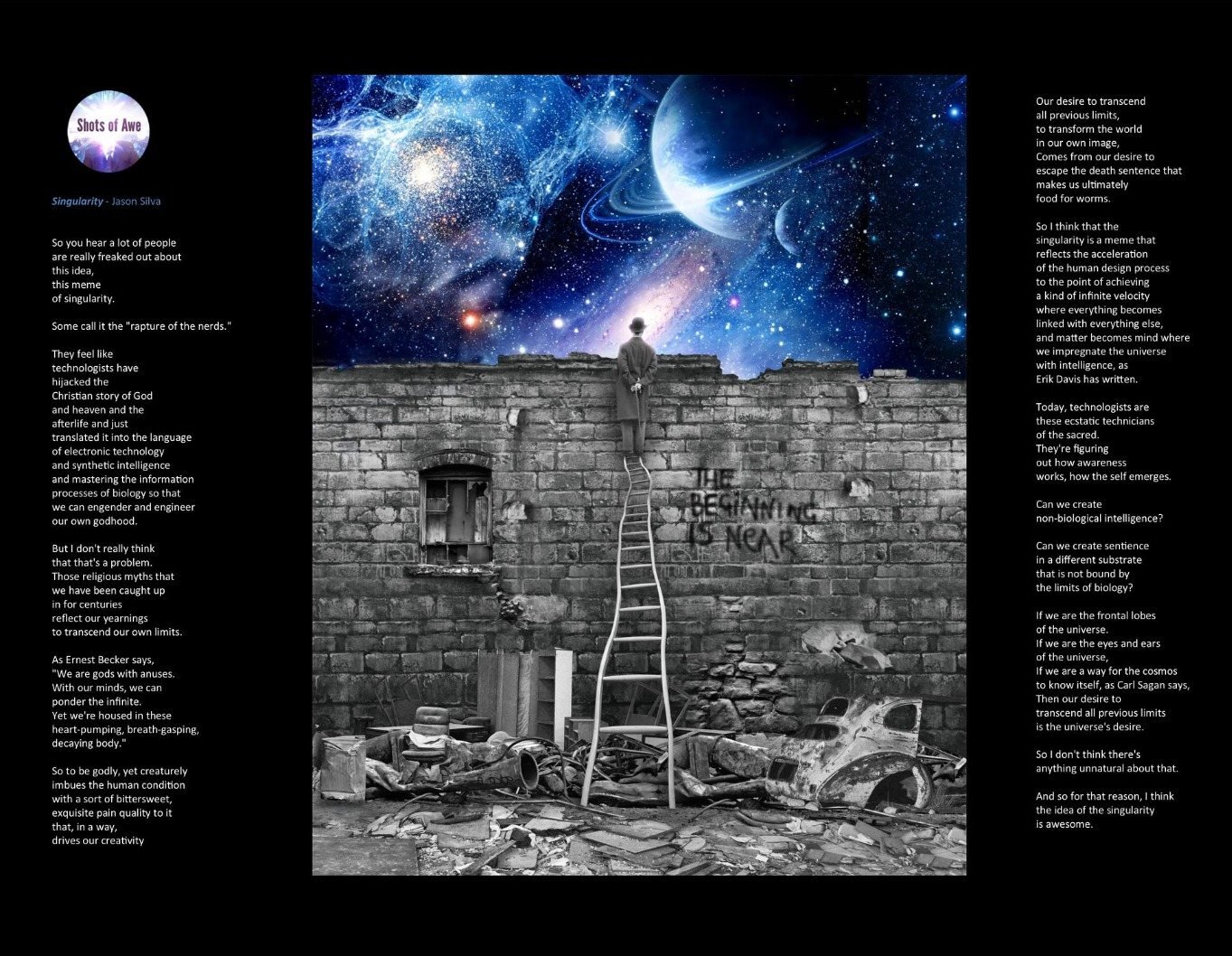
Students read the transcript of Jason Silva’s Shot of Awe on the Singularity as a poem, then take it apart, line by line.

Discuss what these expressions might mean: “Rapture of the nerds”, “Impregnate the universe with intelligence”, “Ecstatic technicians of the sacred”, “Frontal lobes of the universe”, “To be godly, yet creaturely”.
Which thinkers, scientists or authors would you recommend for a deeper understanding of the Singularity, based on this poem? For example Ray Kurzweil, John von Neumann, Vernor Vinge, Erik Davis.
What is the connection between the Technological Singularity and the singularity at the centre of a black hole?
What is a meme?
How will the Singularity change our life?
This House believes that the Singularity is something for humanity to be excited about. This House believes that overcoming death is desirable.
What video clips would you use to develop a deeper understanding of Jason Silva’s thoughts about the Singularity?
Read about Ernest Becker’s book The Denial of Death and highlight ten key points from it.
The central idea of Deep Think is to read Shots of Awe as poetry. Wordsworth called poetry “the spontaneous overflow of powerful feelings”. Jason’s films are just that: unscripted, done in a single take, an overflow of ecstatic delight and cosmic wonder.
The Romantics wrote about love, death, beauty, eternity, nature and the universe, and about the sublime: the awe we feel before something vast. Jason writes about the same things. The difference is where he finds the sublime.
To see a world in a grain of sand,
and heaven in a wild flower,
hold infinity in the palm of your hand,
and eternity in an hour.William Blake, Auguries of Innocence

Called poetry “the spontaneous overflow of powerful feelings”, and found the sublime in mountains, lakes and memory.

The restless Romantic. His verse chases intensity, freedom and the wild grandeur of the sea and the Alps.

Saw “a world in a grain of sand”: the visionary who held infinity in the palm of his hand.

His 1757 Enquiry into the Sublime and Beautiful named the astonishment we feel before something vast.

Painted the Wanderer above the Sea of Fog: one person alone before the immensity of nature.

In What Technology Wants he describes the technium: technology as a living, growing kingdom.

The Denial of Death, his Pulitzer-winning book, asks how awareness of death drives what we create.

The Singularity Is Near maps the exponential growth of technology, the theme of our sample session.
“We fit the universe through our brains, and it comes out in the form of nothing less than poetry.”Jason Silva