If machines can do more and more of our thinking, what is education for? A book that draws on India’s and Asia’s contemplative traditions to answer.

“If machines can increasingly do our thinking for us, might the greatest task of education become teaching us how to be?”The question at the heart of the book
For centuries, schooling has been built around the scarcity of knowledge, the teacher’s monopoly on answers, memorisation, and the idea that academic achievement is the same thing as educational success. Artificial intelligence is emptying the classroom of those assumptions.
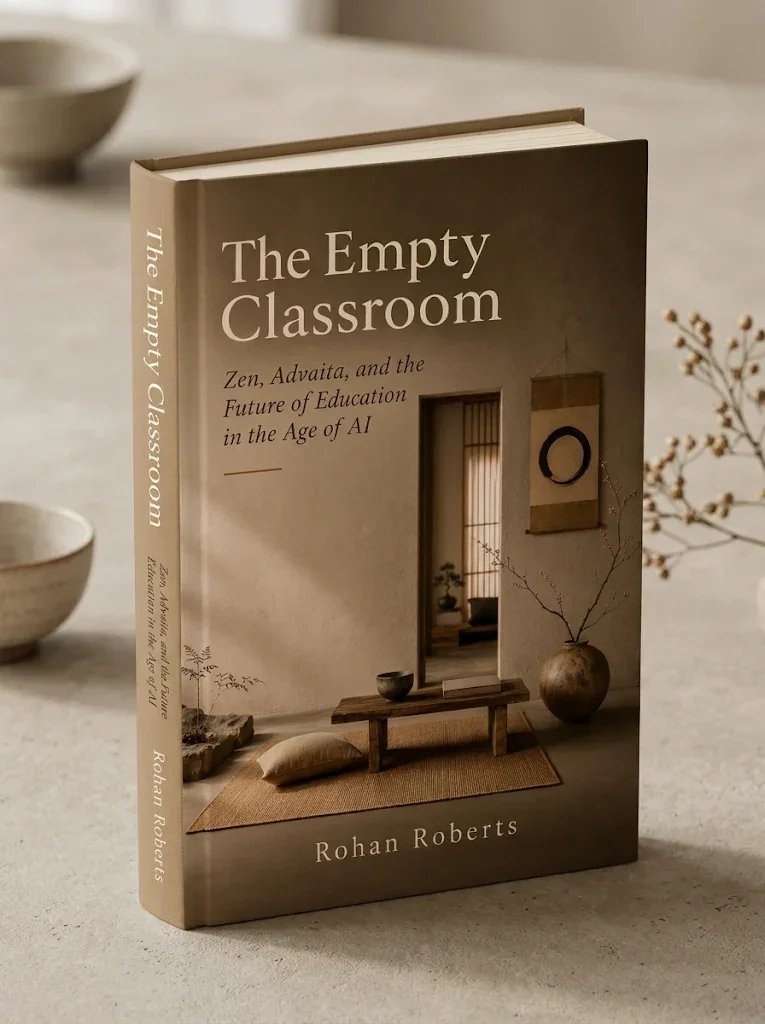
The Empty Classroom argues that this is an extraordinary opportunity. Drawing on Advaita Vedanta and Zen Buddhism, alongside learning science and long experience as an educator, it asks what we should cultivate in young people when knowledge and cognitive skill are no longer scarce.
Its answer: wisdom, self-awareness, inner stillness, compassion, and a felt sense of our connection with other people, all living things, nature and the cosmos. A spirituality without dogma, written with an unmistakably Indian and Eastern voice for readers everywhere, and grounded in science and reason.
The empty classroom is not the end of education. It is the space in which a more meaningful education can begin.
Part I · Emptying: letting go of what no longer serves learning
Part II · Seeing: attention, awareness and the inner life of learning
Part III · Teaching: the practice of education in an age of distraction
Part IV · Becoming: human flourishing in the age of AI
Framed by an introduction, “Why the Classroom Is Becoming Empty”, and a conclusion: “Before Enlightenment, Marking Papers. After Enlightenment, Marking Papers.” The chapter plan may still change as the book is written.
Seeing our own thoughts, feelings and assumptions clearly.
Quiet, sustained attention and equanimity in a world of constant noise.
Kindness and care that reach beyond ourselves, to all living beings.
Knowing ourselves as part of one another, the living world and the cosmos.
Judgement, humility and a sense of what truly matters.
“The empty classroom is not the end of education. It is the space in which a more meaningful education can begin.”
“The Empty Classroom is not ultimately about what artificial intelligence will do to education. It is about what education might finally allow human beings to become.”
A calmer, deeper way to think about the work, as AI changes it.
What we really want for our children, beyond grades.
A case for wisdom and wellbeing at the heart of school.
Zen, Advaita and the Upanishads, made clear for the West.